

Tired: Quantum Computers will Steal Your Bitcoin
Wired: Quantum computers will steal your thoughts.

Dateline: Las Vegas, 29th October 2025.
The CEO of Nvidia, Jensen Huang, is clearly a pretty smart guy (after all, he runs the world’s first $5 trillion company), so the fact that he has turned his attention to quantum computing is significant. He says that there is an “inflection point happening” in technology and that the industry is “within reach” of being able solve some interesting problems in the coming years.
Sooner or Later?
Now, the first thing I think about when someone mentions the interesting problems that quantum computing can solve is the ability to hack Bitcoin and get hold of hundreds of billions of dollars. A 2022 Hudson Institute study estimated that a quantum hack of bitcoin would cause more than $3 trillion in losses across crypto and other markets, meaning that it would trigger a recession, and the cost of Bitcoin has soared since then, meaning the losses would be even higher.
But when will this happen? Huang had previously said that quantum computing was 15-30 years away, while the Microsoft co-founder Bill Gates, said earlier this year that he thought useful quantum computers could arrive in as little as three to five years. In fact he said that “There is the possibility that [Jensen Huang] could be wrong. There is the possibility in the next three to five years that one of these techniques would get enough true logical qubits to solve some very tough problems”.
Now, just as the computer I am typing this on works using binary 1s or 0s “bits”, so a quantum computer uses quantum bits, or “qubits”. To understand what Mr. Huang’s comment you need to understand the difference between physical qubits and logical qubits. A physical qubit is the actual hardware realization of a quantum bit (for example, a tiny superconducting circuit, a trapped ion, or an electron spin) and unlike the 1 or 0 nature of a conventional bit, it can exist in a “superposition” of 0 and 1.
(Don’t worry if you don’t understand what superposition is. It’s something to do with cats in boxes.)
Physical qubits are fragile and all sorts of things ranging from vibration to material defects can induce errors. A logical qubit is built from several physical qubits so that if any one of the physical qubits in the group suffers a glitch, an error correcting algorithm can spot it and the logical state can be restored.
If Nvidia now see an inflection point, then perhaps Mr. Gates is right and the revolution may be here sooner than many people think. The benchmark for those of us in fintech is the 1 million physical qubit threshold estimated as necessary for breaking the widely used RSA-2048 encryption algorithm. The combination of advances in physical qubit engineering and better error correction means that and the fact is that this year has seen a 20-fold decrease in the estimated size of the quantum computer needed crack RSA-2048.
IBM has announced detailed plans to build an error-corrected quantum computer with significantly more computational capability than existing machines by 2028. IBM hopes to make the computer available to users via the cloud by 2029. The machine (codenamed “Starling”) will have 200 logical qubits and after Starling, IBM plans to build another, “Blue Jay”, which will contain 2000 logical qubits and their roadmap aims for 4,000 logical qubits soon after, so the end of RSA-2048 is in sight.
(These developments are not limited to America. In Japan, the National Research and Development Agency, RIKEN, in collaboration with the Japanese IT company Fujitsu, has developed a system with physical 256 qubits and says it aims to launch a 1,000-qubit computer in 2026.)
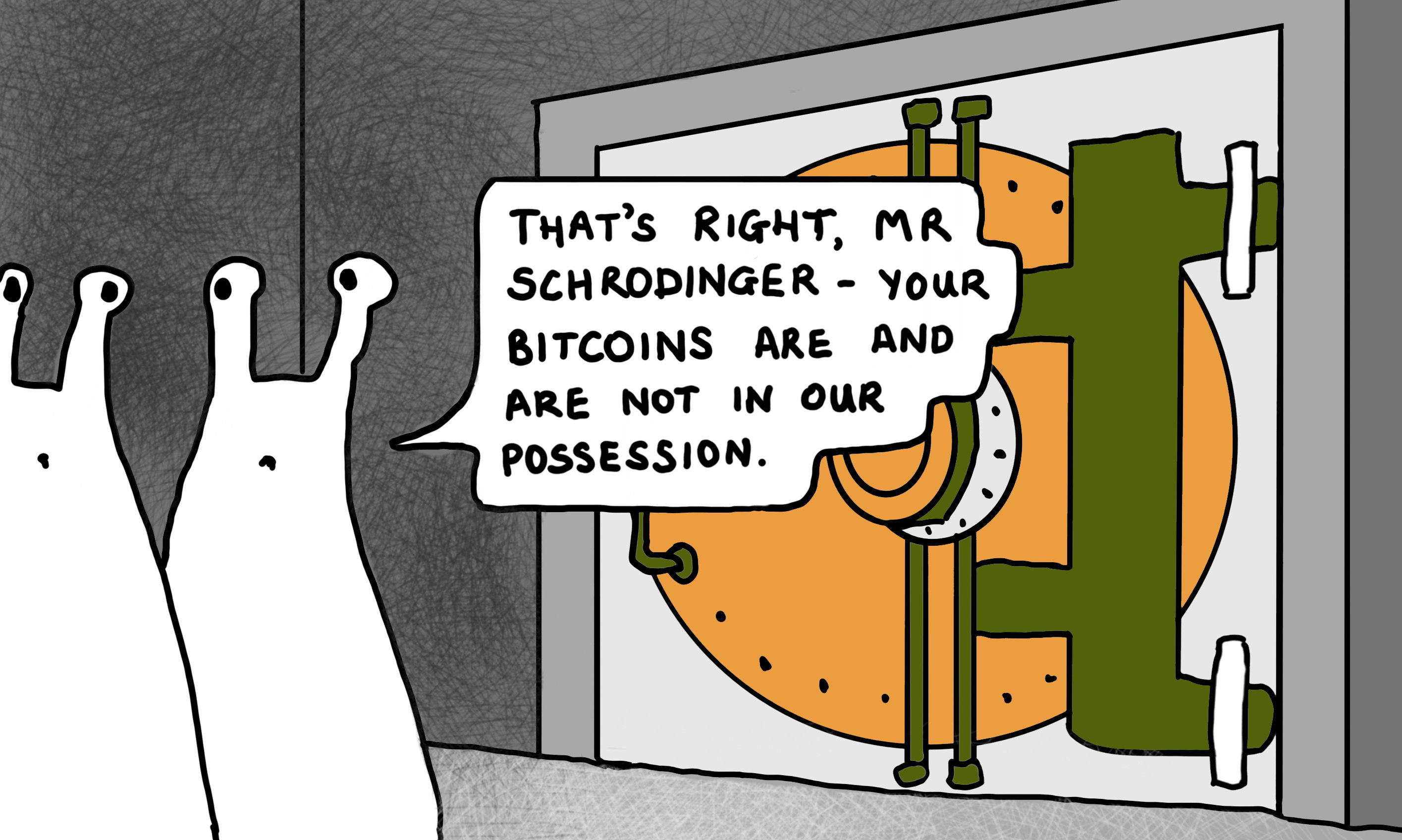
with kind permission of Helen Holmes (CC-BY-ND 4.0)
Meanwhile, Microsoft has just announced that it has invented an entirely new kind of quantum computer which is on a path to create a single quantum computer more powerful than all classical computers on the planet. The company believes that this technology, under development for nearly two decades, will enable the construction of commercially usable and viable quantum computers within five years, which aligns again with Mr. Gates prediction.
Microsoft are far from alone in focusing on quantum. Amazon Web Services announced Ocelot, its first-generation nine qubit quantum computing chip. While the chip has limited computing capabilities—Amazon say it is a proof-of-principle demonstration that shows the architecture is scalable and hardware-efficient—it is a step on the path to creating a larger machine that can deliver on the industry’s promised killer applications, such as fast and accurate simulations of new battery materials.
Be Prepared
Bernard Marr is surely right to say that a couple of decades from now quantum computing will be changing the world in ways we can’t even imagine yet, just as the leap to transistors and microchips enabled the digital world, but we can certainly imagine some of the ways that it could disrupt current systems by rendering widely-used asymmetric cryptography (which powers, for example, the padlock in your web browsers address bar) useless.
This is why I’ve written before about why banks need to start thinking about “Y2Q”, which is when quantum computing will make some current encryption technology obsolete. Well, maybe Y2Q is in sight now. Maybe Y2Q is 2028, which many people seem to think is the right timescale for organisations to complete post-quantum cryptography upgrades—not because quantum computers will definitely be ready by then, but because of uncertainty and the catastrophic risk if they arrive earlier than expected.
Last year a report by the G7 Cyber Expert Group (CEG), which was chaired by the US Department of the Treasury and the Bank of England, highlighted the potential cybersecurity risks associated with developments in quantum computing and the steps that must be taken for financial authorities and institutions to address those risks and, indeed, financial organisations are already preparing for the arrival of quantum computers. Retail, wholesale and central banks themselves are working to develop responses. The Banque de France (BDF) and the Monetary Authority of Singapore (MAS) have already completed a post-quantum cryptography (PQC) experiment designed to enhance cross-border payment security and future-proof financial transactions. By using Microsoft Outlook as the primary email client and incorporating a PQC email plugin, the BDF and MAS successfully exchanged encrypted emails, marking a crucial step toward protecting financial data from future quantum-powered cyber threats.
Just a Thought
The United Nations General Assembly declared 2025 as the International Year of Quantum Science and Technology to foster international partnerships, with a special focus on building capacity in the Global South, advancing gender equality in STEM fields, and tackling the “growing quantum divide”.
It seems appropriate then, during this International Year of Quantum Science and Technology, to think about the implications of large scale quantum computers. Whilst stealing Bitcoin may be an amusing benchmark for quantum prowess (after all, it does not really matter if Bitcoin goes to zero) the real threat to our way of life and well-being is not IBM or Amazon users subverting cryptocurrency but well-funded and highly-motivated nation state adversaries using quantum computers to wreak havoc across business, government and society as a whole.
And that may not even be the most serious implication because in a related field, researchers at the Sussex Centre for Quantum Technologies have developed a microchip that uses quantum computing to detect low frequency electronic fields, opening up the potential for brain scanning with unprecedented accuracy. James Stone, Professor of Psychiatry at Brighton and Sussex Medical School said about this that:
It is an exciting discovery – with development it could open the way for much less intrusive and more detailed 3D imaging of electrical activity in brain, giving the potential to detect which parts of the brain are active in real-time, and potentially giving insights into how thoughts and sensations are represented in the brain.
So it looks like having a quantum computer steal cryptocurrency will be a minor inconvenience when compared to having a quantum computer steal thoughts.
Are you looking for:
A speaker/moderator for your online or in person event?
Written content or contribution for your publication?
A trusted advisor for your company’s board?
Some comment on the latest digital financial services news/media?
Oh oh … and what about the combination of AI and quantum, Dave? I know, dare to dream, but this is really getting scary (if we can no longer assume the good intentions of the people with their fingers on the various triggers). For sure, regulation Is no longer the answer, if it ever was. Imagine, a EAQC (Ethical Aspects of Quantum Computing) regulation to complement the AI act … and what will QC do for making counterfeiting CBDC possible? Is the digital euro QC proof?