

Peaky Fakers
The Nazi plot to destroy our economy.

Dateline: Woking, 6th March 2026.
There was a piece on BBC Radio 4’s flagship news program “Today“ this morning talking about a upcoming film based on the “Peaky Blinders“ television series. I have to admit I’ve never actually seen the programme but I understand it is a very popular depiction of gangsters in the Black Country before the Second World War. On Today, the creator of the series was interviewed about this new film, which it turns out has a plot that revolves around Operation Bernhard.
This caught my ear because Operation Bernhard was a real Nazi plan to try to disrupt the British economy by flooding the country with counterfeit bank notes. It fascinates me for a variety of reasons, so I couldn’t resist posting this more detailed version of an article about the operation that I wrote a while back. I hope you find it interesting given its new context as part of the Peaky Blinders story.
The plan was initially conceived by Alfred Naujocks, but it was expanded and led by SS Major Bernhard Krüger, from whom the operation got its name. The goal was to manufacture large quantities of high-quality forged British pound notes to cause hyperinflation and economic collapse, as well as to fund covert operations and pay for intelligence services. It was a highly successful effort at making fake fivers: the forged notes were considered the most perfect counterfeits ever produced at the time. Large numbers of them were circulated in Europe but they never went into circulation in the UK or damaged the British economy in any way.
Qualitative
If you are curious about the plan, by the way, the story is told in the brilliant film “The Counterfeiters”, which won the 2007 Oscar for best foreign film. The film is based on a memoir written by Adolf Burger, a Jewish Slovak typographer who was imprisoned in 1942 for forging baptismal certificates to save Jews from deportation. The Nazis took Burger and more than a hundred other Jews from a variety of trades — printing, engraving and at least one convicted master counterfeiter, Salomon Smolianoff — and moved them from different death camps to a special unit: “Block 19” in Sachsenhausen concentration camp. There they set about forging first the British and then the American currency.
(The BBC produced a comedy drama series based on Operation Bernhard in the early 1980s, “Private Schulz”. The characters were based on the real inmates of Sachsenhausen, where 30,000 people were murdered during the course of the war.)
In the end, the prisoners forged around £132 million, which is about five billion dollars in today’s prices. The forgeries were perfect, but the fact is that the Nazi’s dastardly plan probably wouldn’t have worked. They were churning out fake “white fivers” (as shown below) and bigger notes at a time when the average weekly wage in Britain was £5. The Bank of England, who were wise to the plot, were concerned that the counterfeiters might make lower denominations. For this reason, it had to make contingency plans to withdraw the £1 note and the ten shilling note. So Waddington’s Games, the makers of Monopoly, were engaged to print five shilling and two-and-half shilling notes to replace coins instead of the game currency!
As the Allied armies converged on Berlin, the contents of Block 19, including printers’ plates and counterfeit bills, were jammed into crates and chucked into Lake Toplitz in Austria. These crates were subsequently retrieved by treasure hunters searching for Nazi gold and looted art, which is how come some of the notes were preserved for collectors (indeed, I have one of the original counterfeit notes in front of me as I write) and in a supreme irony some of the notes ended up being used to purchase arms for the nascent Israeli army instead of providing unauthorised quantitative easing in wartime England.
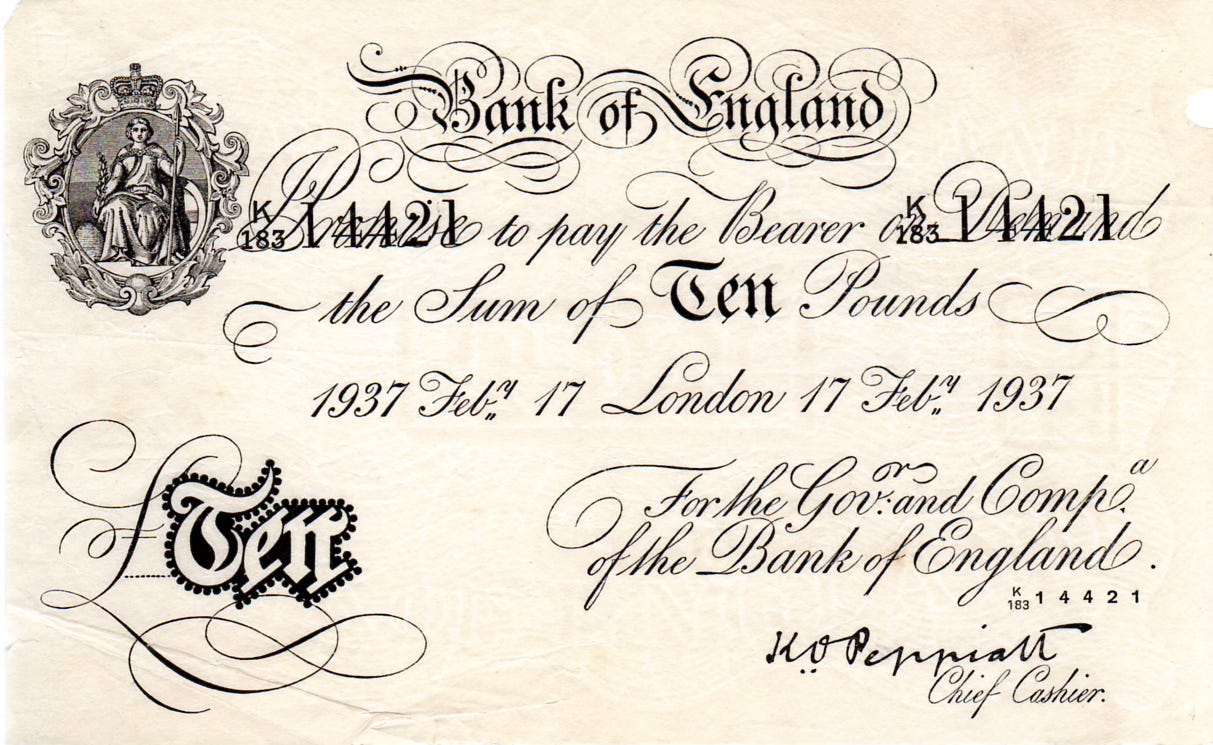
A recovered Operation Berhard counterfeit note. I bought it from a collector some years ago after reading about the donation of Felix Cytrin’s Sachsenhausen drawings to Yad Vashem.
Quantitative
The Nazis were never able to put their plot into operation. They planned to drop the worthless banknotes out of planes flying over England, thus causing economic instability, inflation and recession. Remember, in 1939 the German people had very recent memory of worthless paper currency devastating the economy, so to them this must have seemed like a weapon of mass destruction. However, as I pointed out in my book Before Babylon, Beyond Bitcoin, printing four billion quid’s worth of worthless paper money not backed by anything might sound like a reasonable way to destabilise the British economy, but during the Great Financial Crisis the Bank of England printed more than two hundred billion imaginary pounds (ie, fifty times as much as the Nazis) and rather than crash the economy, they stabilised it.